


CA3ViAR - Composite fan Aerodynamic, Aeroelastic and Aeroacoustic VAlidation Rig
In the scope of this project a representative low-speed fan for UHBR engines has been developed and validated, investigating aerodynamic, aeroelastic and aeroacoustic instabilities. IBK led coordination, mechanical design and manufacturing.
Project Overview
CA3ViAR (Composite Aeroelastic and Aeroacoustic Validation in Research) was an EU-funded research project under the Clean Sky 2 Joint Undertaking (Horizon 2020). Its goal was to design, manufacture and experimentally validate a low-speed composite fan demonstrator that reproduces the instability mechanisms typical for Ultra High Bypass Ratio (UHBR) propulsion systems used in next-generation civil aircraft.
The project addressed the industrial challenge of developing efficient and lightweight fan systems while maintaining aeroelastic stability and acoustic performance. Increasing the bypass ratio (BPR) improves propulsive efficiency and reduces fuel consumption, yet also narrows the stable operating range and increases the risk of stall and flutter. Furthermore, larger fan diameters introduce complex aerodynamic interactions at the Aerodynamic Interface Plane (AIP), particularly under off-design and crosswind conditions.
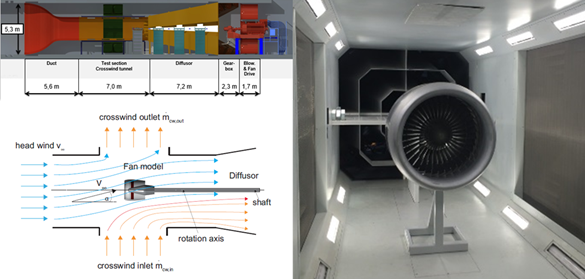
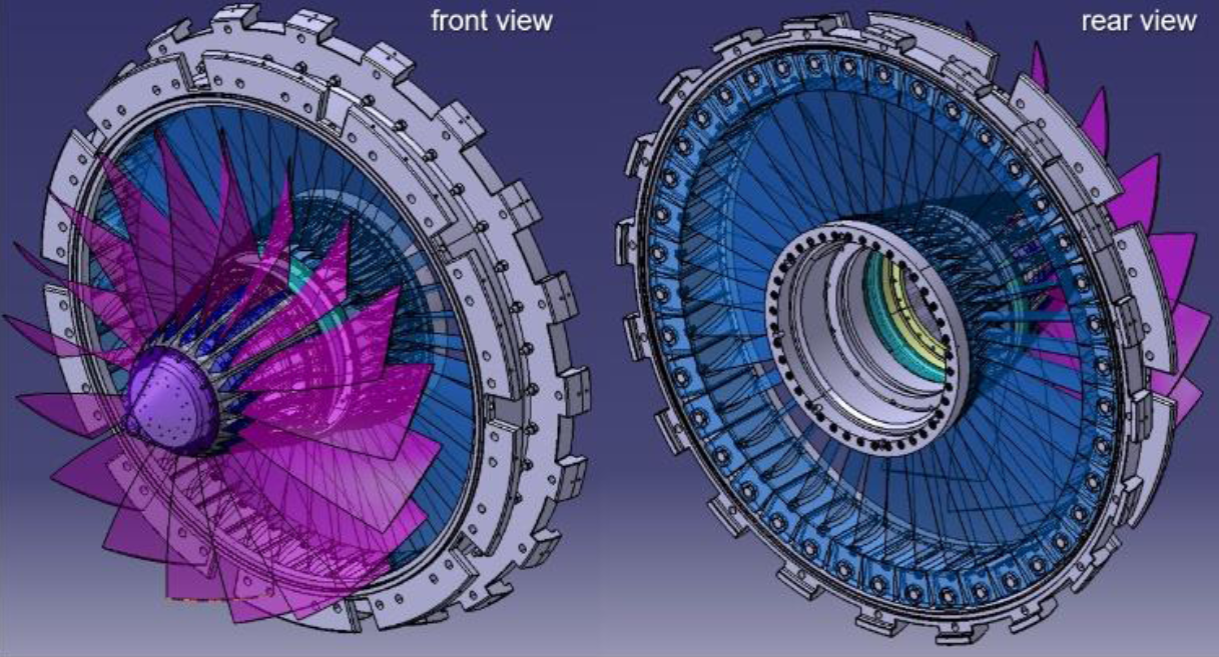
To manage these effects, CA3ViAR designed a Low-Transonic Fan (LTF) with a composite rotor intentionally tailored to exhibit representative instabilities within safe limits during testing. The use of Carbon Fibre Reinforced Polymer (CFRP) enabled precise control of stiffness and mass distribution, supporting advanced aeroelastic design. The fan was tested in the Propulsion Test Facility (PTF) at Technische Universität Braunschweig, Germany, where aerodynamic, aeroelastic and aeroacoustic performance was measured over a broad operating envelope, including conditions close to stall and flutter boundaries.
The project combined numerical simulation and experimental validation to improve predictive accuracy in fan design. CFD (RANS/URANS), FEM modal and flutter analysis, and aeroacoustic prediction tools were benchmarked and refined against test data. This integration of computation and experiment supports the next generation of reliable design methodologies for UHBR fans.
Contributions & Deliverables
IBK Innovation GmbH & Co. KG coordinated the project and led the mechanical design of the LTF demonstrator, including the detailed structural design, rotor–stator integration, and supervision of manufacturing through specialized subcontractors. IBK also contributed to the aeroelastic analysis and provided interface management between design and test partners.
Technische Universität Braunschweig (TUBS) led aerodynamic design, rig instrumentation, and test execution in the PTF. Leibniz Universität Hannover (LUH) provided aeroelastic and aeroacoustic modeling expertise, conducting both pre- and post-test analyses. DREAM Innovation srl (Italy) supported aerodynamic shaping and CFD post-test correlation.
By the end of 2023, CA3ViAR successfully delivered a validated open test case for composite UHBR fan research. The resulting experimental and numerical dataset enables future research in coupled aeroelastic and aeroacoustic design methods and serves as a benchmark for both academic and industrial applications.
Partners

IBK Innovation GmbH & Co. KG
Project coordination, mechanical and aeroelastic design, manufacturing supervision.

Technische Universität Braunschweig (TUBS)
Aerodynamic design, instrumentation, test execution.

Leibniz Universität Hannover (LUH)
Aeroelastic and aeroacoustic modeling and validation.

DREAMS Innovation Srl
CFD analysis and aerodynamic support.
Methods, Tools & Facilities
Methods
CFD (RANS/URANS), FEM modal and flutter analysis, aeroacoustic simulation, composite optimization
Tools
ANSYS, NASTRAN, OpenFOAM, MATLAB, Python
Facilities
Propulsion Test Facility (PTF) at TU Braunschweig, low-speed test rig with crosswind capability
Additional Information
Funding
- Funding body: Clean Sky 2 Joint Undertaking (EU Horizon 2020)
- Grant number: 864256
- Required sentence: “This project has received funding from the Clean Sky 2 Joint Undertaking under the European Union’s Horizon 2020 research and innovation programme under grant agreement No 864256.”
- Logos usage permission: yes
Duration
09/2019 - 12/2023
- Design & Simulation (2019-2021)
- Manufacturing (2022)
- Experimental Testing and Validation (2023)