




ALEGRO – Advanced Load Evaluation by Groundbreaking Optimization
ALEGRO achieved faster and more accurate aircraft load predictions by integrating deep-learning algorithms into structural dynamics. IBK enhanced aeroelastic modeling and process automation within this framework.
Project Overview
ALEGRO aimed to revolutionize the field of aircraft load prediction by introducing deep-learning methodologies and advanced problem-specific modeling techniques into the existing design workflow. Traditionally, load calculations during flight or ground impact rely on deterministic, simulation-based approaches using coupled models that solve flight-mechanical equations of motion. While this process ensures reliability, it is time-consuming and constrained by the computational complexity of high-fidelity simulations.
The project addressed the increasing industrial demand for faster and more accurate methods in structural dynamics and load evaluation, aligning with the "Industry 4.0" paradigm. This includes the integration of self-learning algorithms, data-driven model correction, and the efficient handling of large datasets generated during aerodynamic and structural analyses.
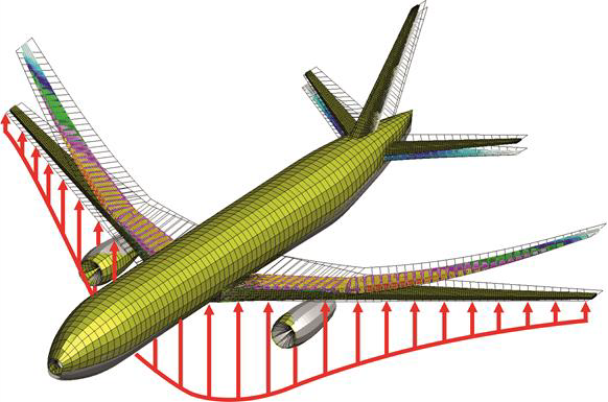
Generic long-range configuration.
ALEGRO tackled key technical challenges such as coupling excitations in high-frequency domains to better represent structural dynamics, correcting aerodynamic Doublet Lattice Models (DLM) for transonic flow conditions in the early design phase, and simplifying complex certification analyses. A notable example includes a reduced-order modeling approach that drastically decreased the computation time required for ditching and evacuation simulations while maintaining accuracy.
The project’s novelty lay in combining physics-based simulation with artificial intelligence, allowing for hybrid models that learn from prior analyses and experimental data. Through this, prediction quality and process robustness were significantly enhanced.
IBK Innovation contributed to the development and validation of aeroelastic and structural dynamic models, focusing on the coupling between aerodynamic excitations and structural response. The company was responsible for improving the numerical efficiency of these models and implementing modular interfaces enabling fast data exchange across simulation environments. IBK’s role also included process optimization for load evaluation chains and the introduction of automated model calibration procedures based on machine-learning feedback loops.
Overall, ALEGRO demonstrated the feasibility and benefits of AI-augmented engineering workflows in aircraft load analysis, setting a foundation for future industry adoption.
Contributions & Deliverables
- Development of reduced-order aeroelastic models for transonic flow applications
- Implementation of machine-learning-based model correction framework
- Validation of coupled load prediction toolchain using Airbus reference cases
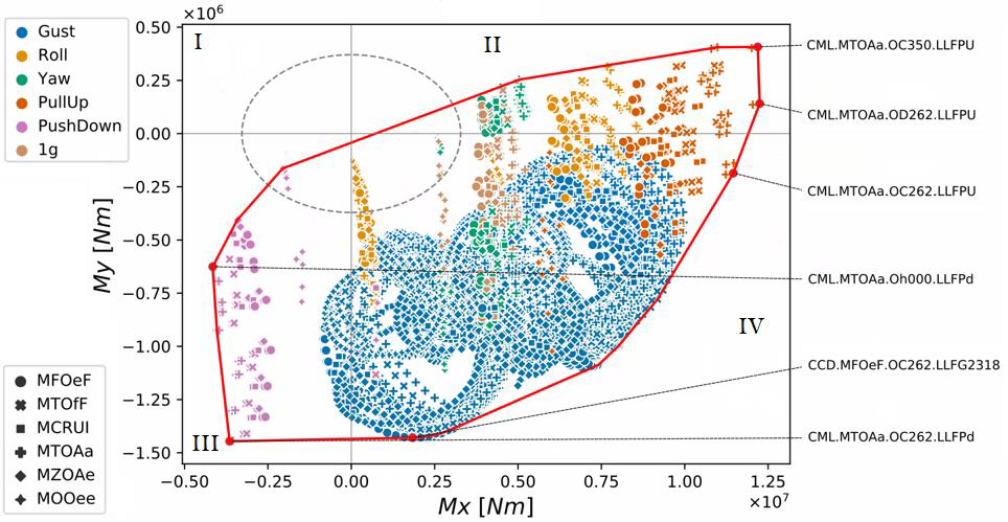
Exemplaric envelope.
Partners
IBK Innovation GmbH & Co. KG
Development of coupled structural-aerodynamic modeling and process automation
Airbus
Project lead, coordination and industrial implementation
DLR (German Aerospace Center)
Method development for load modeling (KONPRIU)
TU Braunschweig
Academic partner, algorithmic development
Methods, Tools & Facilities
Methods
CFD (RANS, DLM correction), FEM modal analysis, reduced-order modeling, AI-based model calibration
Tools
ANSYS, Python (TensorFlow, SciPy), MATLAB/Simulink
Facilities
Numerical aeroelastic test environments and process automation pipelines
Additional Information
Funding
- Funding body: Bundesministerium für Wirtschaft und Klimaschutz (BMWK)
- Program: LuFo V-3
- Grant number: 20A1709D
- “This project is funded by the German Federal Ministry for Economic Affairs and Climate Action under the national aviation research program LuFo V-3.”
Duration
01/2019 – 03/2022 Project executed in sequential phases:
model development, AI-integration, validation and final industrial evaluation.