



ERACLE – invEstigation of pushing pRopeller engine Configurations trough wind tunneL Experiments
ERACLE experimentally investigated the aeroacoustic behavior of pushing propeller configurations to improve prediction tools for propeller–wing installations. IBK led coordination and wind tunnel model design.
Project Overview
ERACLE (invEstigation of pushing pRopeller engine Configurations trough wind tunneL Experiments) was a research project funded by the Clean Sky 2 Joint Undertaking under the European Union’s Horizon 2020 Programme. Its objective was to experimentally investigate the aeroacoustic characteristics of pusher-type propeller configurations and validate advanced design tools for the preliminary evaluation of propeller–wing arrangements.
The project addressed a key challenge in modern aircraft design: combining aerodynamic efficiency with acceptable noise emissions. While pusher configurations can offer improved propulsive efficiency, since they operate in a flow already slowed down by the wing and fuselage they also tend to generate complex acoustic phenomena due to turbulent wake interactions and reflection effects from nearby aircraft surfaces.
Two categories of installation effects were central to ERACLE’s research:
- Aerodynamic effects, where the upstream wing and nacelle modify the inflow and turbulence characteristics at the propeller blades;
- Acoustic effects, where noise propagation is influenced by reflection and refraction from the airframe geometry.
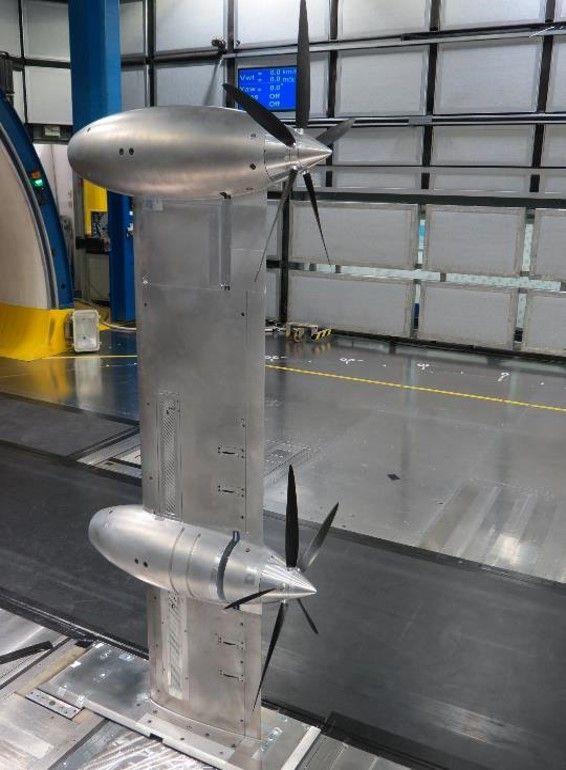
The ERACLE consortium designed, manufactured and tested a two-dimensional wing model equipped with an active boundary layer control system (suction and blowing) to simulate different aerodynamic flow states. The setup also included custom-designed propeller assemblies, hubs, spinners, fairings, and mechanisms allowing adjustable propeller–wing distances and configurations.
Experimental campaigns were performed in the acoustic low-speed wind tunnel of Pininfarina (Italy), subcontracted for testing. The experiments captured both near-field and far-field acoustic data under controlled aerodynamic conditions. The collected data were processed and analyzed to quantify the influence of installation geometry, boundary layer characteristics and inflow distortion on the emitted noise.
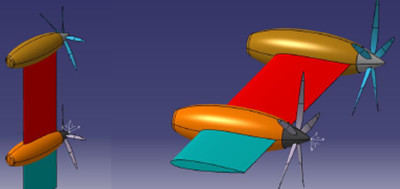
CAD Design of concept.
A major objective was the validation and enhancement of Airbus Defence & Space’s acoustic pre-design toolset, which predicts noise generation and propagation for propeller-wing systems in early design stages. By correlating experimental data with computational predictions, ERACLE delivered improved parameterizations for aerodynamic installation effects and provided a reliable database for future propeller aircraft development.
IBK Innovation GmbH & Co. KG coordinated the project and led the wind tunnel model design, ensuring mechanical and aerodynamic integration across subsystems. IBK was responsible for the definition of model interfaces, mechanical design of adjustable propeller installations, and coordination of manufacturing and testing activities.
NHOE led the system-level design of the wind tunnel model and test setup. UNIROMA3 managed the acoustic pre-design toolset and test campaign, and Eligio Refraschini (ERF) performed detailed model manufacturing, instrumentation and assembly within the test facility.
By successfully combining advanced experimental techniques and numerical model development, ERACLE contributed significantly to understanding the complex interactions between propeller aerodynamics and acoustics, paving the way for quieter, more efficient future propeller aircraft.
Contributions & Deliverables
- Coordination and overall project management
- Wind tunnel model and mechanical integration design
- Manufacturing supervision and integration with acoustic test rig
- Contribution to model validation and correlation of acoustic data
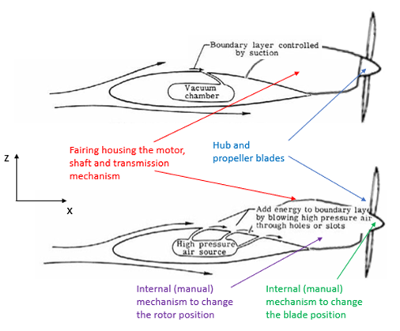
Schematic drawing.
Partners
IBK Innovation GmbH & Co. KG
Project coordination, WT model design and system integration
NHOE
Wind tunnel model systems design leader
UNIROMA3
Acoustic pre-design toolset development and test campaign management
Eligio Refraschini (ERF)
Model manufacturing, instrumentation and wind tunnel implementation
Methods, Tools & Facilities
Methods
Aeroacoustic testing, boundary layer control, CFD and hybrid aeroacoustic modeling, experimental–numerical data correlation
Tools
ANSYS Fluent, OpenFOAM, MATLAB, LabVIEW
Facilities
Acoustic large low-speed wind tunnel of Pininfarina (Italy)
Additional Information
Funding
- Funding body: Clean Sky 2 Joint Undertaking (EU Horizon 2020)
- Grant number: 687015
- “This project has received funding from the Clean Sky 2 Joint Undertaking under the European Union’s Horizon 2020 research and innovation programme under grant agreement No 687015.”
Duration
07/2018 – 06/2020 (24 months)
Phases: model design and manufacturing (2018–2019),
instrumentation and testing in Pininfarina wind tunnel (2019–2020).