




ESTRO – Experimental and Numerical Validation of the Regional Turboprop Wing
ESTRO experimentally and numerically validated the aerodynamic and laminar flow performance of a regional turboprop wing equipped with morphing devices. IBK led aero-structural analyses and flight extrapolation.
Project Overview
ESTRO (Experimental and Numerical Validation of the Regional Turboprop Wing) was a Clean Sky 2 Joint Undertaking (Horizon 2020) project supporting the Regional Aircraft (REG) platform led by Leonardo Aircraft. Its goal was to provide validated aerodynamic and laminar-flow data for the next-generation 90-seat turboprop (TP90) regional aircraft through coordinated wind tunnel testing and numerical simulation.
The project focused on the design and validation of a Natural Laminar Flow (NLF) wing featuring morphing high-lift and load control devices. This approach directly contributes to Clean Sky 2’s strategic goals of reducing fuel burn, emissions, and noise by improving aerodynamic efficiency across a broad flight envelope.
The experimental campaign was conducted at both low-speed and transonic conditions, covering Mach numbers up to 0.67 and Reynolds numbers up to 11 million. The tests were performed in a large European transonic wind tunnel with excellent flow quality, ensuring reliable measurement of pressure distributions, laminar flow extent, wing deformation, and load control behavior.
Parallel to the experimental work, extensive numerical simulations were performed to correlate and extrapolate wind tunnel data to full-scale flight conditions. These included CFD analyses of boundary layer behavior, linear stability evaluations based on ray theory, and aero-structural coupled simulations that accounted for elastic deformation and morphing surface flexibility.
A key research focus was the interaction between morphing droop nose geometry and aerodynamic performance. The impact of flexibility and geometric imperfections on laminar flow robustness was analyzed, along with the effectiveness of load control devices in different flight regimes. Additionally, the influence of propeller slipstream on laminar flow extension was investigated through three-dimensional boundary-layer simulations.
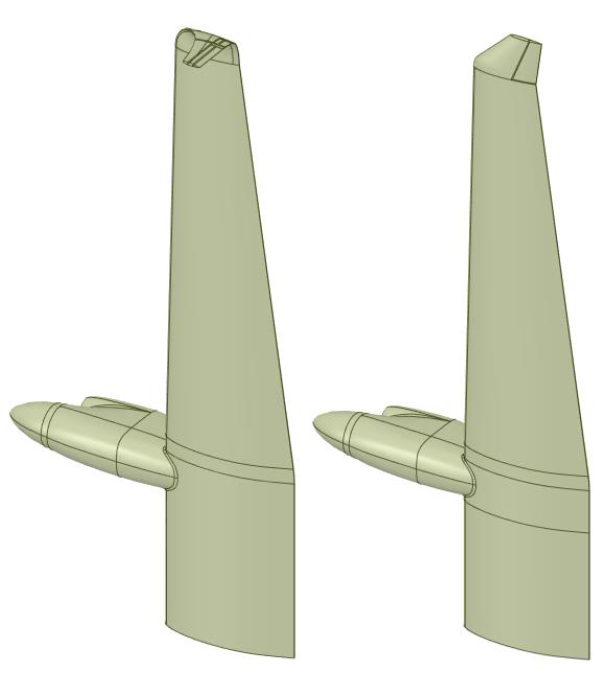
CLEAN-AWL (a) and CLEAN-IWT (b) configurations
Within the consortium, IBK Innovation GmbH & Co. KG was responsible for aero-structural modeling and simulation, including coupled aeroelastic analyses of the morphing wing and extrapolation of wind tunnel data to flight conditions. IBK’s work enabled accurate prediction of aerodynamic loads and deformations at realistic Reynolds and Mach conditions, bridging the gap between experimental data and operational performance.
The project was coordinated by the University of Salerno (UNISA), which conducted CFD simulations and overall project management. Dream Innovation srl led the wind tunnel test campaign and contributed to numerical analysis and correlation activities.
Over its 36-month duration, ESTRO successfully delivered a validated aerodynamic and aero-structural dataset that advances the understanding of laminar flow technologies and morphing high-lift concepts for future regional turboprop aircraft.
Contributions & Deliverables
- Aero-structural coupled simulations for morphing wing (2020)
- Extrapolation of WT measurements to flight conditions (2021)
- Support to laminar flow robustness assessment and load control studies (2021)
- Delivery of aeroelastic dataset for TP90 wing validation (2021)
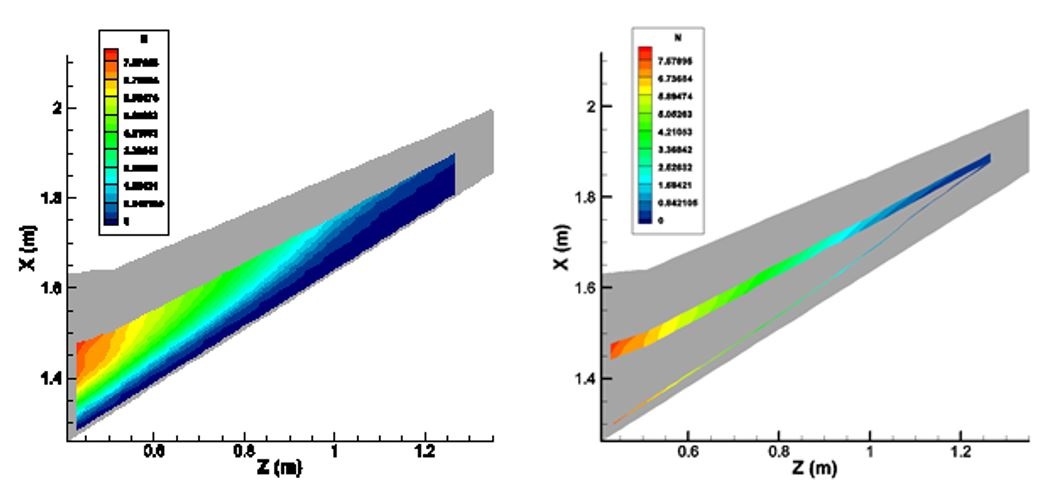
Map (left) and origin (right) of the most amplified disturbances on a regional NLF wing.
Partners
IBK Innovation GmbH & Co. KG
Aero-structural coupled analyses, flight condition extrapolation
University of Salerno (UNISA)
Project coordination and CFD simulations
Dream Innovation sr
Wind tunnel test execution and numerical correlation
German-Dutch Wind Tunnel
Wind tunnel test facility
Methods, Tools & Facilities
Methods
CFD (RANS/transition modeling), FEM aeroelastic coupling, boundary-layer stability analysis, data extrapolation
Tools
ANSYS Fluent, NASTRAN, MATLAB, Python
Facilities
Large European Transonic Wind Tunnel DNW (high Reynolds No. up to 11 × 10⁶)
Additional Information
Funding
- Funding body: Clean Sky 2 Joint Undertaking (EU Horizon 2020)
- Grant number: 831809
- “This project has received funding from the Clean Sky 2 Joint Undertaking (JU) under the European Union’s Horizon 2020 research and innovation programme under grant agreement No 831809.”
Duration
01/2019 – 12/2021 (36 months) Phases: numerical design and CFD (2019–2020), experimental campaign
and correlation (2020–2021), final validation (2021).