



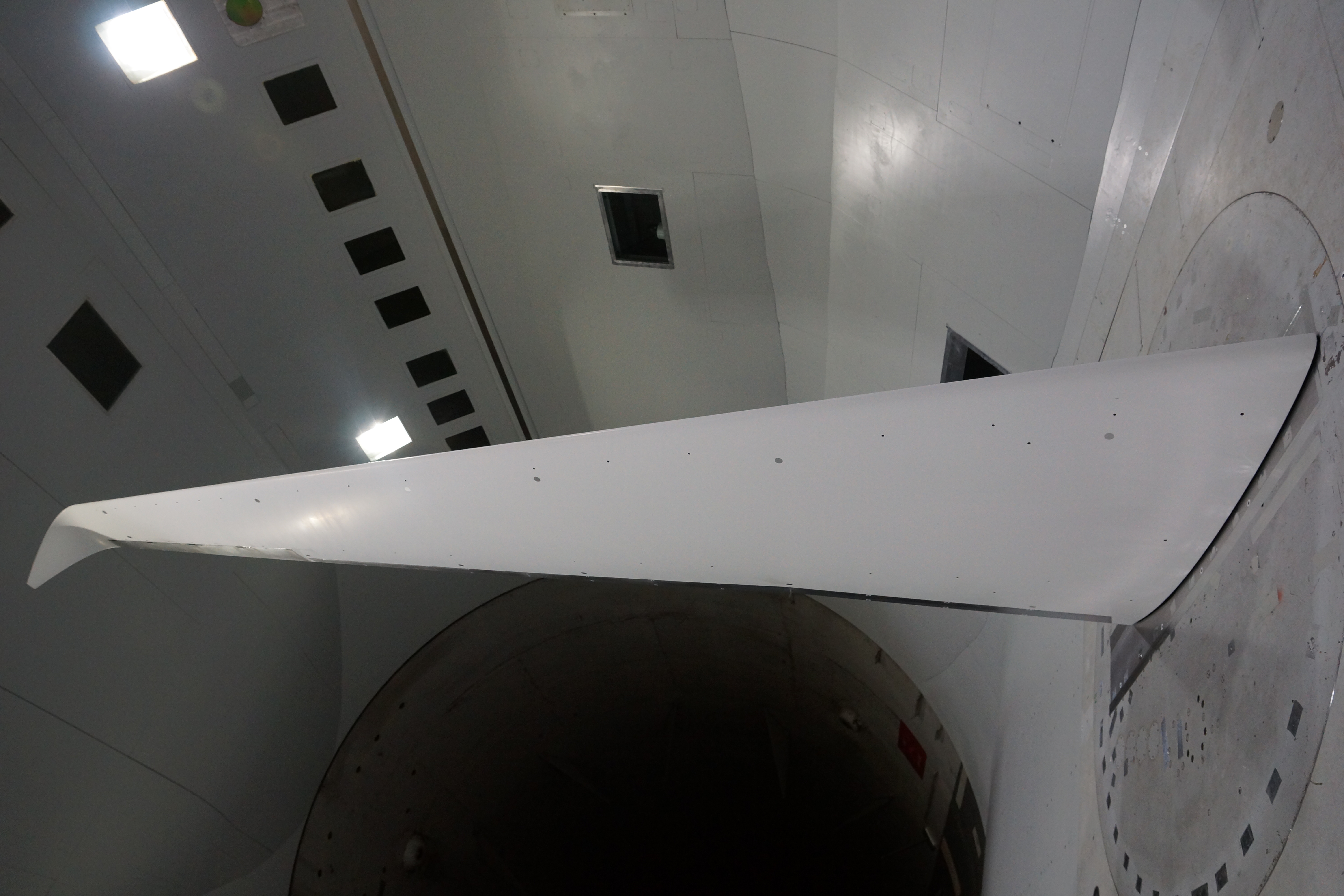
ETRIOLLA – Experimental Transonic Investigations on Laminar Flow and Load Alleviation
ETRIOLLA designed and tested an elastic, natural laminar flow (NLF) transonic wing with active load control and alleviation systems. IBK coordinated the project and led model design and aeroelastic simulation.
Project Overview
ETRIOLLA (Experimental Transonic Investigations on Laminar Flow and Load Alleviation) was a Clean Sky Joint Undertaking (FP7) project dedicated to developing and testing a large-scale elastic NLF wing model under transonic and off-design conditions. The goal was to validate aerodynamic performance, laminar flow robustness and load control strategies for future “greener” aircraft configurations, supporting the ACARE 2020 vision for sustainable aviation.
Natural Laminar Flow (NLF) technology aims to maintain laminar boundary layer flow over as much of the wing surface as possible, minimizing drag and noise. Achieving this in realistic conditions requires both high Reynolds numbers and precise surface quality. To replicate flight-relevant aerodynamic behavior, the ETRIOLLA model was built at a scale of 1:3.05 with a span of 5.6 m, designed to operate at cruise Mach numbers (~0.74) in the ONERA S1 transonic wind tunnel (France).
Due to the extreme sensitivity of laminar flow to surface imperfections, the model’s aerodynamic surface was manufactured to exceptionally tight tolerances, and elastic deformation under aerodynamic load was intentionally included in the design process. The so-called “hot shape” design ensured that the model would achieve the correct aeroelastic twist under load, resulting in realistic flow conditions during testing.
To maximize test flexibility, the ETRIOLLA wing featured five remotely actuated movable devices, each equipped with real-time position and force sensing. These devices allowed optimization of Load Control & Alleviation (LC&A) settings during wind tunnel runs. IBK Innovation developed and validated these systems through a dedicated flap demonstrator in the company’s laboratory, simulating bending and torsion effects on the hinge mechanisms prior to model integration.
Parallel to the design and manufacturing, extensive aerodynamic and structural simulations were conducted to predict loads, deformations and dynamic behavior. Before the wind tunnel tests, the University of Bristol (UOB) performed static load and ground vibration tests (GVT) to verify stiffness and dynamic characteristics and to assess flutter and divergence safety.
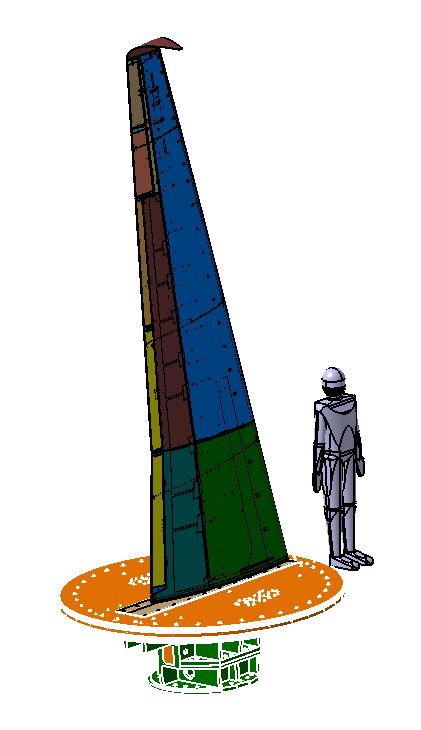
CAD model of Wind-Tunnel-Model
The wind tunnel campaign at ONERA delivered exceptional results: under cruise conditions (Mach 0.74), laminar flow extended over approximately 70 % of the upper surface and 30 % of the lower surface - an outstanding outcome for a transonic configuration. The campaign also confirmed the efficiency of LC&A systems in optimizing aerodynamic load distribution and delaying flow transition.
ETRIOLLA introduced several technological innovations, including:
the world’s first large-scale elastic laminar wind tunnel model with remote-controlled flaps,
real-time actuation and force sensing,
tight geometric tolerances and accurate prediction of “hot shape” deformation through simulation, and
application of genetic optimization algorithms for design-space exploration.
These achievements earned ETRIOLLA a nomination for the Clean Sky “Best Project Award”. The project demonstrated the feasibility of highly integrated experimental–numerical approaches to laminar flow and load control research, pushing the boundaries of aerodynamic testing and model design.
Contributions & Deliverables
- Project coordination and system-level management (2013–2016)
- Elastic NLF wind tunnel model design and simulation (2014–2015)
- Actuation demonstrator and lab validation of LC&A systems (2015)
- Successful transonic WT campaign and laminar flow validation at ONERA (2016)
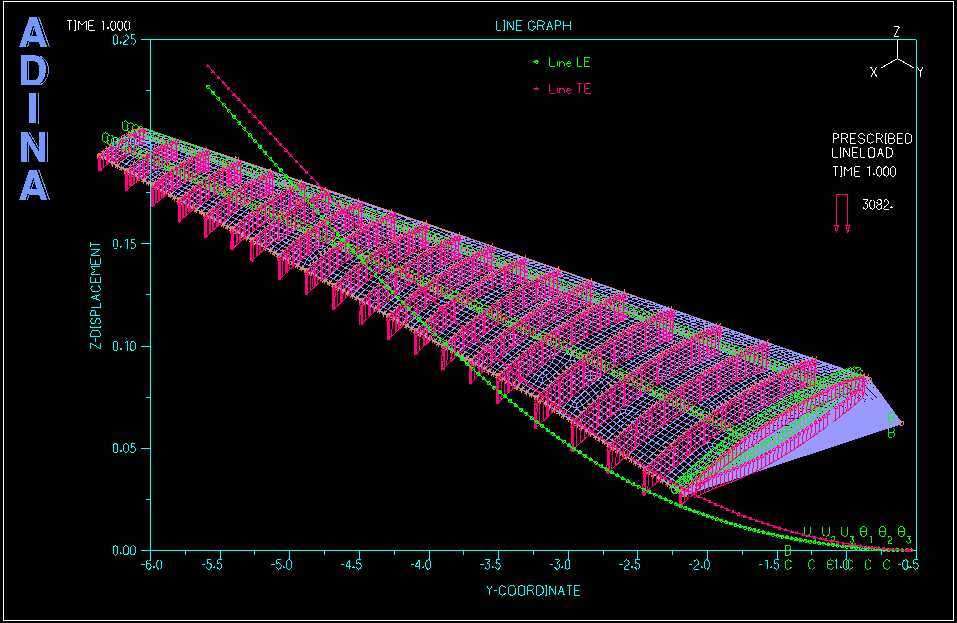
Numerical simulation the wing.
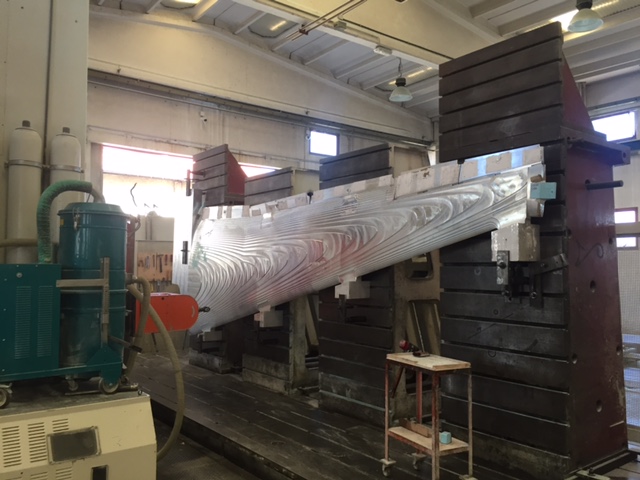
Milling process of the prototype.
Partners
IBK Innovation GmbH & Co. KG
Project coordination, WT model design, CFD and structural simulations
University of Bristol (UOB)
Static load and ground vibration tests, structural validation
FOI – Totalförsvarets forskningsinstitut
CFD simulations and aerodynamic analysis
Eligio Re Fraschini S.p.A.
Model manufacturing and assembly
ONERA
Wind tunnel testing and infrared laminar flow visualization
Methods, Tools & Facilities
Methods
CFD, FEM, aeroelastic simulation, LC&A optimization, infrared laminar detection, genetic optimization algorithms
Tools
ANSYS Fluent, NASTRAN, MATLAB, Python, in-house IBK optimization framework
Facilities
ONERA S1 transonic wind tunnel (France)
Additional Information
Funding
- Funding body: Clean Sky Joint Undertaking (EU FP7)
- Grant number: 323460
- “This project has received funding from the Clean Sky Joint Undertaking under the European Union’s Seventh Framework Programme for research, technological development and demonstration under grant agreement No 323460.”
Duration
01/2013 – 12/2016
Phases: model design and actuation system development (2013–2014), manufacturing and validation
(2015), wind tunnel testing and optimization (2016).