



GLAMOUR – Gust and Load Alleviation Models for Unified Research
GLAMOUR demonstrated Natural Laminar Flow (NLF) and active load alleviation technologies for the Green Regional Aircraft through advanced control concepts and wind tunnel validation. IBK designed the gust generator and detailed wind tunnel model.
Project Overview
GLAMOUR (Gust and Load Alleviation Models for Unified Research) was a Clean Sky Joint Undertaking (FP7) project supporting the Green Regional Aircraft (GRA) platform. The project focused on the experimental and numerical validation of advanced Manoeuvre Load Alleviation (MLA) and Gust Load Alleviation (GLA) systems for a Natural Laminar Flow (NLF) wing configuration representative of future low-emission regional aircraft.
The goal was to assess and demonstrate active control strategies that reduce structural loads and vibrations under gust and manoeuvre excitation, improving both aerodynamic efficiency and structural lifetime. GLAMOUR combined innovative control algorithms with a comprehensive wind tunnel test campaign to achieve a full experimental validation of MLA and GLA methods.
A key challenge of the project was the complexity of the aeroelastic model tested, a complete semi-span aircraft configuration featuring multiple movable control surfaces, embedded instrumentation, and full aeroelastic representation of the wing and tailplane. The model was tested in a free-free configuration to simulate realistic flight boundary conditions.
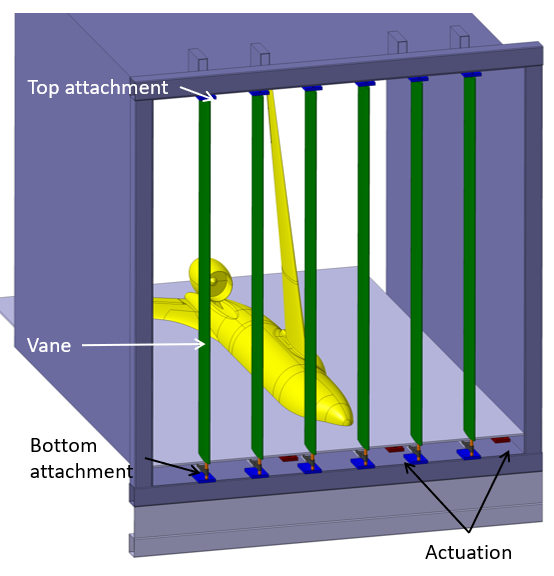
CAD model of the half model and test section.
To replicate atmospheric disturbances, a dedicated gust generator was developed and installed in the GVPM large low-speed wind tunnel at Politecnico di Milano (POLIMI). The generator, jointly designed by IBK Innovation GmbH & Co. KG and POLIMI, consists of six electrically actuated vanes capable of reproducing gust fields compliant with EASA CS-25 certification regulations for large aircraft. This system enabled precise and repeatable simulation of gust loads in controlled conditions.
Several control architectures were investigated and implemented, including:
Static Output Feedback (SOF) and Robust Model Predictive Control (RMPC) for deterministic load reduction,
Neural Network–based controllers for adaptive response, and
Local Direct Control (LDC) for gust compensation using tailplane and aileron coupling.
The wind tunnel model was manufactured by Revoind Industriale under POLIMI’s coordination, while University of Bristol (UOB) and Technion – Israel Institute of Technology contributed to control law development and optimization. IBK Innovation provided the detailed design of both the gust generator and wind tunnel model, ensuring aeroelastic integrity and mechanical compatibility, and offered on-site support during the testing campaign.
The experimental validation successfully demonstrated that the integration of MLA and GLA strategies in an NLF configuration can effectively mitigate structural loads under realistic turbulence excitation. The results proved the synergy between aerodynamic design, control theory and experimental aerodynamics, contributing valuable insights for future regional aircraft design within Clean Sky’s GRA platform.
GLAMOUR was considered one of the flagship achievements within Clean Sky for its combined innovation in experimental infrastructure, model design, and control validation, and it directly supported the European objective of advancing environmentally friendly aircraft technologies.
Contributions & Deliverables
- Design and implementation of six-vane gust generator for large WT testing (2015)
- Detailed mechanical and aeroelastic design of the NLF wind tunnel model (2015–2016)
- On-site testing and support for MLA/GLA validation campaign (2016)
- Contribution to Clean Sky GRA demonstrator database and control law evaluation (2016)
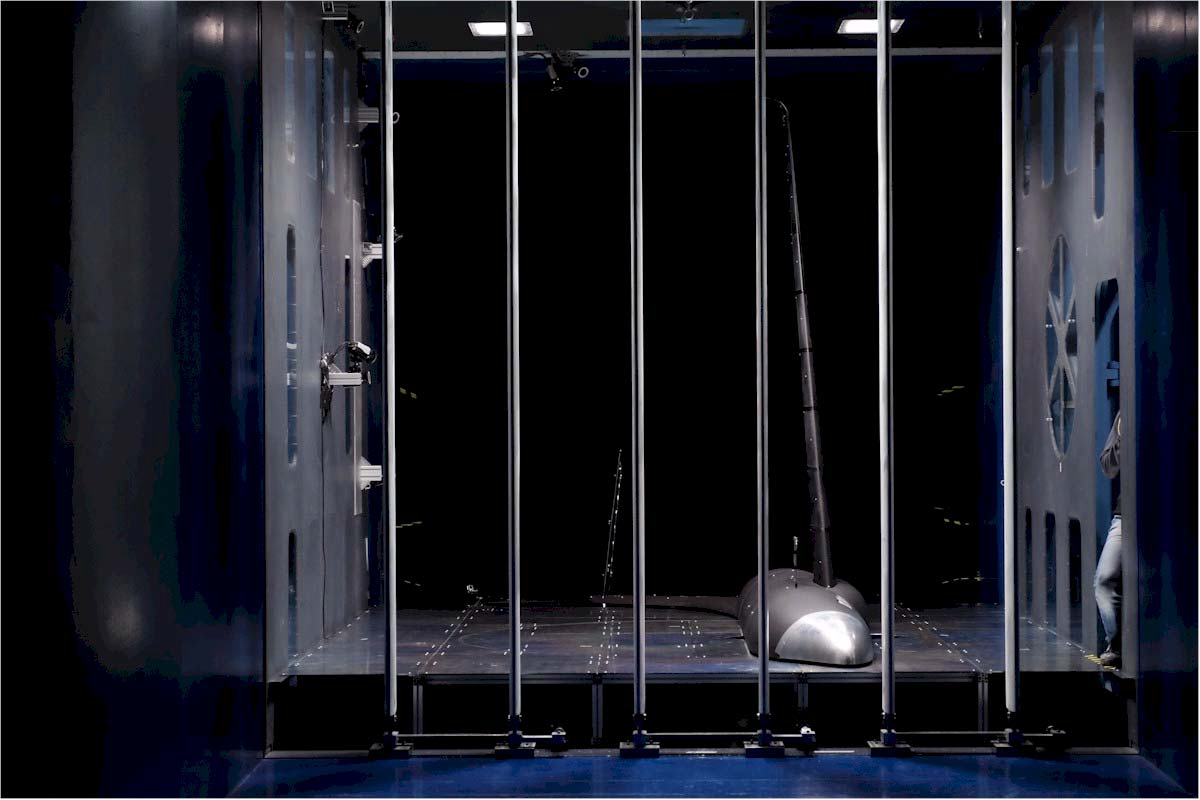
Prototype in wind tunnel.
Partners
IBK Innovation GmbH & Co. KG
Detailed design of gust generator and WT model, experimental support
Politecnico di Milano (POLIMI)
Project coordination, preliminary WT model design, control-law development, test campaign management
Technion – Israel Institute of Technology
Control law optimization and validation
University of Bristol (UOB)
Development of alternative control laws, support during wind tunnel testing
Methods, Tools & Facilities
Methods
Wind tunnel testing under gust excitation, active control validation, aeroelastic design, model predictive control
Tools
MATLAB/Simulink, ANSYS, CATIA V5, dSPACE real-time control platform
Facilities
GVPM Low-Speed Large Wind Tunnel, Politecnico di Milano (Italy)
Additional Information
Funding
- Funding body: Clean Sky Joint Undertaking (EU FP7)
- Grant number: 620084
- “This project has received funding from the Clean Sky Joint Undertaking under the European Union’s Seventh Framework Programme for research, technological development and demonstration under grant agreement No 620084.”
Duration
02/2014 – 12/2016 (34 months)
Phases: conceptual design and control architecture definition (2014), model manufacturing and gust
generator development (2015), wind tunnel testing and data analysis (2016).