



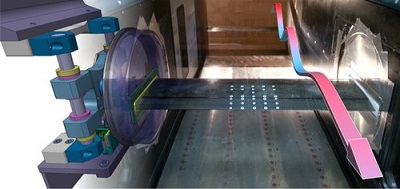
GUDGET – Gust and Dynamic Load Experimental Testing
GUDGET developed an advanced gust generator and aeroelastic half-model for transonic wind tunnel testing at ONERA S3Ch, enabling experimental validation of gust load prediction methods. IBK coordinated the project and led gust generator and model design.
Project Overview
GUDGET (Gust and Dynamic Load Experimental Testing) was a Clean Sky 2 Joint Undertaking (Horizon 2020) project dedicated to the experimental investigation of gust-induced loads on aeroelastic aircraft models under transonic flow conditions. Its goal was to generate a comprehensive experimental database for validating and improving numerical tools that predict aircraft response to gust excitations, a key topic for next-generation aircraft design and certification.
The motivation behind GUDGET stemmed from the growing need to experimentally validate gust load prediction methods at high amplitudes and transonic speeds. Existing computational approaches often lack sufficient reference data for validation, especially in the nonlinear regime where structural and aerodynamic coupling effects dominate.
To address this gap, GUDGET designed and implemented a complete experimental setup for ONERA’s transonic facility S3Ch. The setup comprises two main elements:
- An enhanced gust generator system capable of reproducing realistic atmospheric disturbances within a high-speed flow environment.
- An aeroelastic half-model, heavily instrumented and equipped with an active aileron featuring a piezoelectric actuator, allowing in-tunnel implementation of load alleviation strategies.
The gust generator had to meet exceptionally demanding specifications, including gust amplitudes up to ±1° and a frequency bandwidth from 0 to 100 Hz at Mach numbers up to 0.82. To satisfy these conditions, several design concepts were analyzed - ranging from mechanically actuated tilting airfoils to fluidic blowing slots, as well as hybrid combinations of both. A trade-off study, supported by CFD simulations, identified the most effective configuration in terms of frequency response, control authority and integration feasibility.
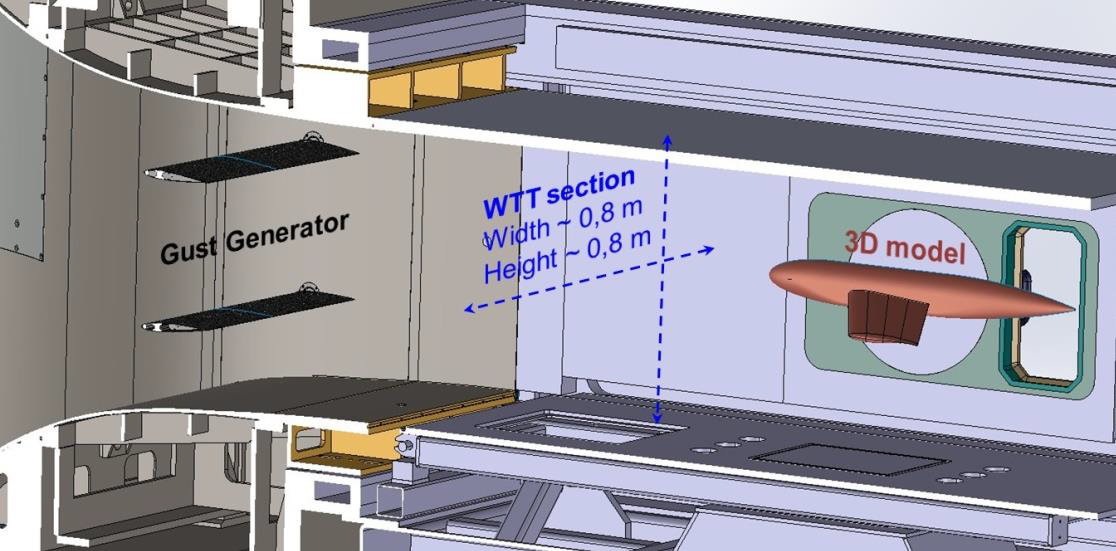
CAD depiction of the test section.
The selected design combines innovative tilting-vane mechanisms with fluidic enhancement to generate controlled, repeatable gusts compatible with ONERA’s transonic test section. The aeroelastic model, meanwhile, features integrated instrumentation including pressure taps, pressure sensors, and accelerometers, ensuring precise measurement of aerodynamic and structural responses.
The project required tight coordination due to the interdisciplinary nature of the tasks and the high-performance requirements for both mechanical and actuation systems. IBK Innovation GmbH & Co. KG coordinated the consortium and acted as design leader for both the gust generator and the wind tunnel model. IBK was responsible for system integration, mechanical design, and technical support during test preparation and operation.
POLIMI supported the gust generator and WT model design, DREAM Innovation srl performed CFD-based optimization of the system architecture, AVDES managed manufacturing and instrumentation, and CTEC developed the actuation mechanisms for both the gust generator and the aeroelastic model.
Upon completion, GUDGET successfully demonstrated the feasibility of generating high-amplitude gusts in a transonic flow environment and produced valuable experimental data for validating aeroelastic and control models. These results contribute to advancing gust load prediction and alleviation methods within the Clean Sky 2 program.
Contributions & Deliverables
- Coordination of consortium and detailed design of gust generator and model (2019–2020)
- Support to ONERA for test preparation and integration (2020–2021)
- Validation of actuation system performance up to 100 Hz bandwidth (2021)
- Delivery of transonic gust load database for numerical validation (2021)
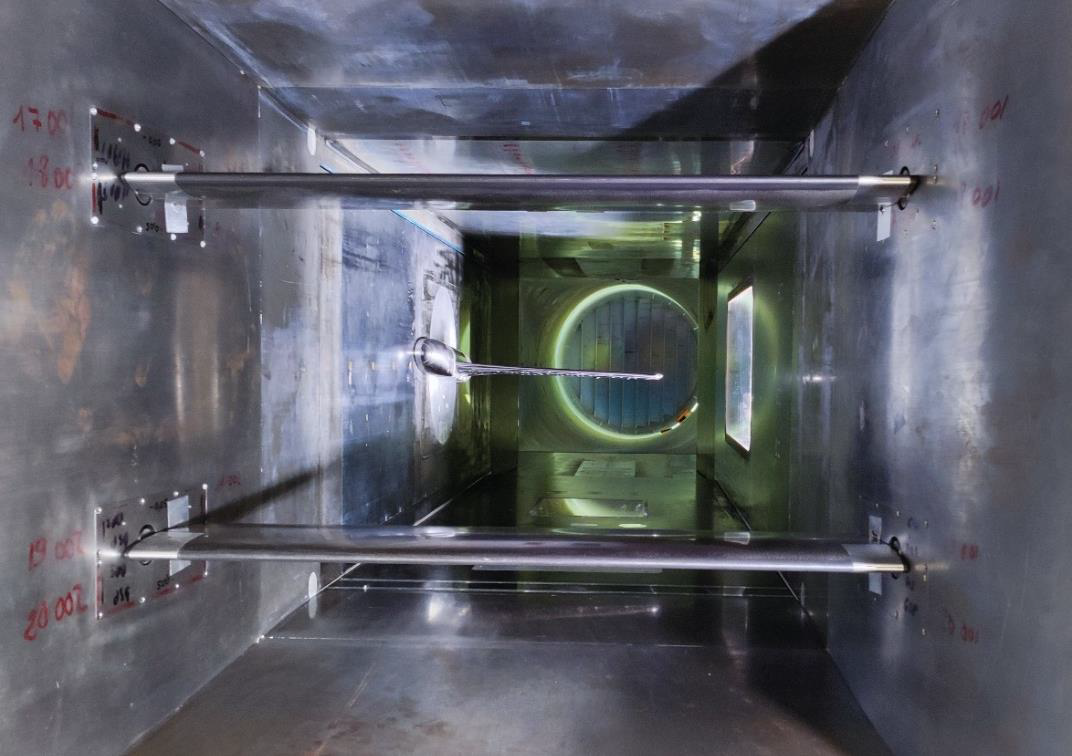
Test section in the wind tunnel
Partners
IBK Innovation GmbH & Co. KG
Project coordination, gust generator and WT model design, test support
Politecnico di Milano (POLIMI)
Support for design of gust generators and WT model
DREAM Innovation srl
CFD-based architecture optimization of gust generator
AVDES
Manufacturing and instrumentation of gust generator and WT model
CTEC
Design and implementation of actuation systems
Methods, Tools & Facilities
Methods
CFD-assisted gust generator optimization, aeroelastic modeling, dynamic load measurement, actuation system testing
Tools
ANSYS Fluent, CATIA V5, MATLAB/Simulink, LabVIEW
Facilities
ONERA S3Ch transonic wind tunnel (France)
Additional Information
Funding
- Funding body: Clean Sky 2 Joint Undertaking (EU Horizon 2020)
- Grant number: 831802
- “This project has received funding from the Clean Sky 2 Joint Undertaking under the European Union’s Horizon 2020 research and innovation programme under grant agreement No 831802.”
Duration
03/2019 – 02/2021 (24 months) Phases: conceptual and trade-off design (2019), detailed design and
manufacturing (2020), integration and test preparation at ONERA (2021).