



INFLIGHT – Innovative Gust Load Alleviation using Forward-Looking Sensors
INFLIGHT developed a model predictive gust load alleviation system using real-time LIDAR wind measurements to actively reduce structural loads and vibrations in flight. IBK coordinated the project and provided the aero-structural modeling and control design basis.
Project Overview
INFLIGHT (Innovative Gust Load Alleviation using Forward-Looking Sensors) was funded under the German National Aeronautical Research Program (LuFo V-3) and focused on the development of a next-generation gust load alleviation system (GLAS) combining LIDAR-based gust detection with model predictive control (MPC) strategies. The system’s purpose was to actively mitigate aerodynamic and structural loads caused by atmospheric disturbances and to improve passenger comfort by reducing vibration levels.
Traditional load alleviation systems use reactive control logics triggered by indirect indicators such as load factor or acceleration. Their performance is inherently limited, as control actions occur only after the gust has already impacted the aircraft. INFLIGHT addressed this limitation by introducing a forward-looking LIDAR sensor that detects approaching gusts up to 200 m ahead of the aircraft, providing the predictive controller with sufficient lead time for anticipative control actions.
The MPC framework was designed to minimize defined cost functions representing structural loads, actuator deflections, and passenger comfort objectives. This approach allows dynamic trade-offs between load alleviation and control effort in real time. The primary goal was to reduce peak loads at critical structural points such as the wing root, enabling potential structural weight savings and thus lower fuel burn and CO₂ emissions.
The system was implemented and tested on an ultralight Remos GX aircraft, serving as the experimental flight demonstrator. The setup included:
- A LIDAR sensor provided and integrated by the Institut für Flugführung (IFF) of Technische Universität Braunschweig (TUBS) for measuring gust velocities ahead of the aircraft,
- A real-time predictive control system developed by the Institute for Automation Engineering (IFAT) at Otto-von-Guericke-Universität Magdeburg (OVGU), and
- A structural and aerodynamic model created by IBK Innovation GmbH & Co. KG, which also defined control objectives, performance metrics and coordinated overall system integration.
The subcontractor messWERK GmbH provided the test aircraft and supported instrumentation and data acquisition.
For the first time, INFLIGHT demonstrated the feasibility of real-time coupling of LIDAR-based gust measurements with predictive control algorithms in an airborne environment. Flight data confirmed the system’s ability to anticipate and mitigate gust loads, achieving significant reductions in structural stress and cabin vibration amplitude compared to conventional reactive systems.
The project’s results underline the potential of predictive control with forward-sensing technologies as a key enabler for lighter, more efficient, and safer aircraft. The developed methods are applicable across future manned and unmanned platforms, directly supporting Germany’s and Europe’s long-term aviation sustainability goals.
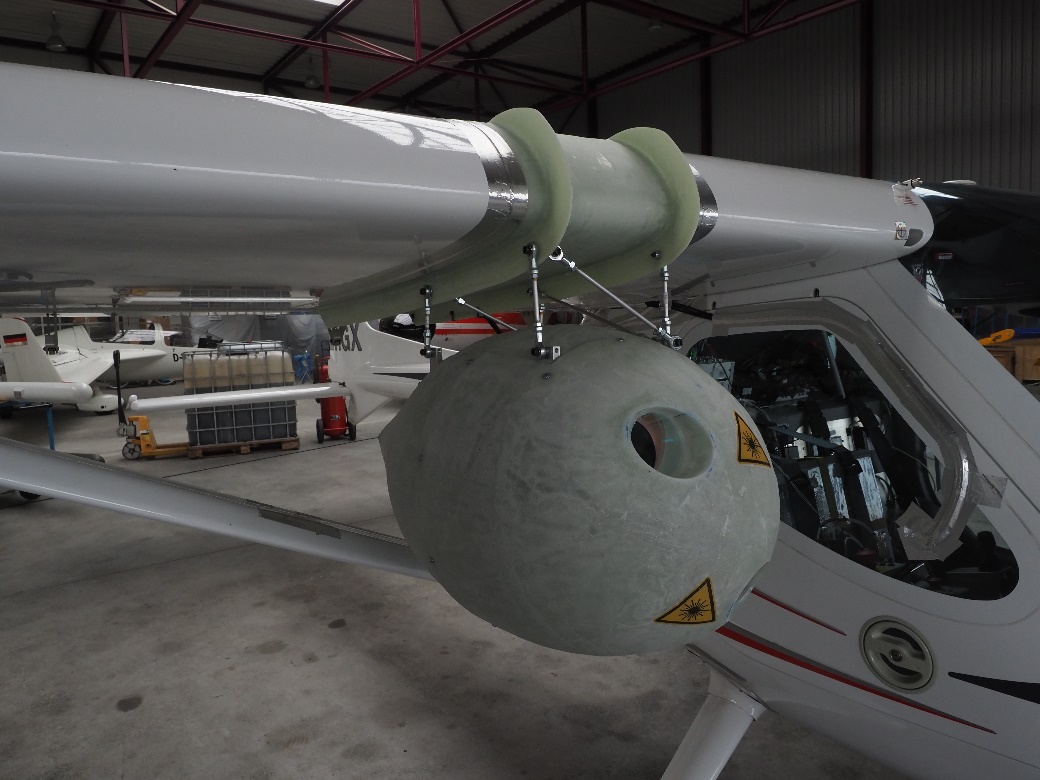
Dedicated mass positioning.
The system was implemented and tested on an ultralight Remos GX aircraft, serving as the experimental flight demonstrator. The setup included:
A LIDAR sensor provided and integrated by the Institut für Flugführung (IFF) of Technische Universität Braunschweig (TUBS) for measuring gust velocities ahead of the aircraft,
A real-time predictive control system developed by the Institute for Automation Engineering (IFAT) at Otto-von-Guericke-Universität Magdeburg (OVGU), and
A structural and aerodynamic model created by IBK Innovation GmbH & Co. KG, which also defined control objectives, performance metrics and coordinated overall system integration.
The subcontractor messWERK GmbH provided the test aircraft and supported instrumentation and data acquisition.
For the first time, INFLIGHT demonstrated the feasibility of real-time coupling of LIDAR-based gust measurements with predictive control algorithms in an airborne environment. Flight data confirmed the system’s ability to anticipate and mitigate gust loads, achieving significant reductions in structural stress and cabin vibration amplitude compared to conventional reactive systems.
The project’s results underline the potential of predictive control with forward-sensing technologies as a key enabler for lighter, more efficient, and safer aircraft. The developed methods are applicable across future manned and unmanned platforms, directly supporting Germany’s and Europe’s long-term aviation sustainability goals.
Contributions & Deliverables
- Development of structural and aerodynamic model for MPC control (2018–2019)
- System integration of predictive controller with LIDAR-based measurement (2020)
- Flight test validation and data evaluation on Remos GX (2021)
- Quantified load reduction and vibration suppression analysis (2021)
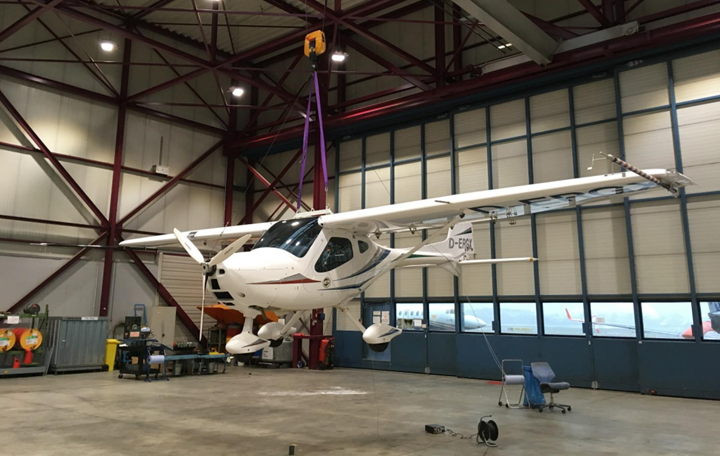
Testing facility.
Partners
IBK Innovation GmbH & Co. KG
project coordination, aero-structural modeling, control system design, integration management
Technische Universität Braunschweig (TUBS), Institut für Flugführung (IFF)
development and integration of LIDAR-based gust detection
Otto-von-Guericke-Universität Magdeburg (OVGU), Institute for Automation Engineering (IFAT)
implementation of model predictive control and real-time system integration
Methods, Tools & Facilities
Methods
Model predictive control (MPC), aeroelastic modeling, real-time sensor fusion, flight test data evaluation
Tools
MATLAB/Simulink, Python, NI LabVIEW, Dymola
Facilities
Flight test platform Remos GX (messWERK GmbH), IFF sensor lab (TUBS)
Additional Information
Funding
- Funding body: German Federal Ministry for Economic Affairs and Energy (BMWi) Program: LuFo V-3
- Grant number: 20Q1711A
- “This project has received funding from the German Federal Ministry for Economic Affairs and Energy (BMWi) within the national aviation research program LuFo V-3 under grant agreement no. 20Q1711A.”
Duration
01/2018 – 12/2021 (48 months) Phases: conceptual design and modeling (2018–2019), integration and
ground testing (2020), flight testing and evaluation (2021).