




UHURA
Research on unsteady aerodynamics and dynamic loads of Krueger flap deployment and retraction, with IBK contributing coupling tools, FSI analysis and data management.
Project Overview
The UHURA project investigates the complex aeroelastic and aerodynamic phenomena associated with the deployment and retraction of Krueger flaps in modern high-lift systems. These devices, crucial for take-off and landing performance, are subject to strong unsteady aerodynamic effects and dynamic loads during motion, which are insufficiently understood and thus require comprehensive research.
The challenge arises from the Krueger flap’s thin structural configuration and intricate motion kinematics, leading to coupled fluid-structure interaction (FSI) phenomena. The project’s aim is to enhance the predictability and reliability of these interactions through advanced simulation and experimental validation.
UHURA’s objectives are threefold.
First, to validate numerical simulation methods capable of accurately predicting unsteady aerodynamic behavior and dynamic loads during Krueger movement.
Second, to experimentally characterize the aerodynamic properties of slotted Krueger devices using wind tunnel testing and numerical approaches.
Third, to assess design implications on handling qualities, certification aspects, and potential structural weight reduction.
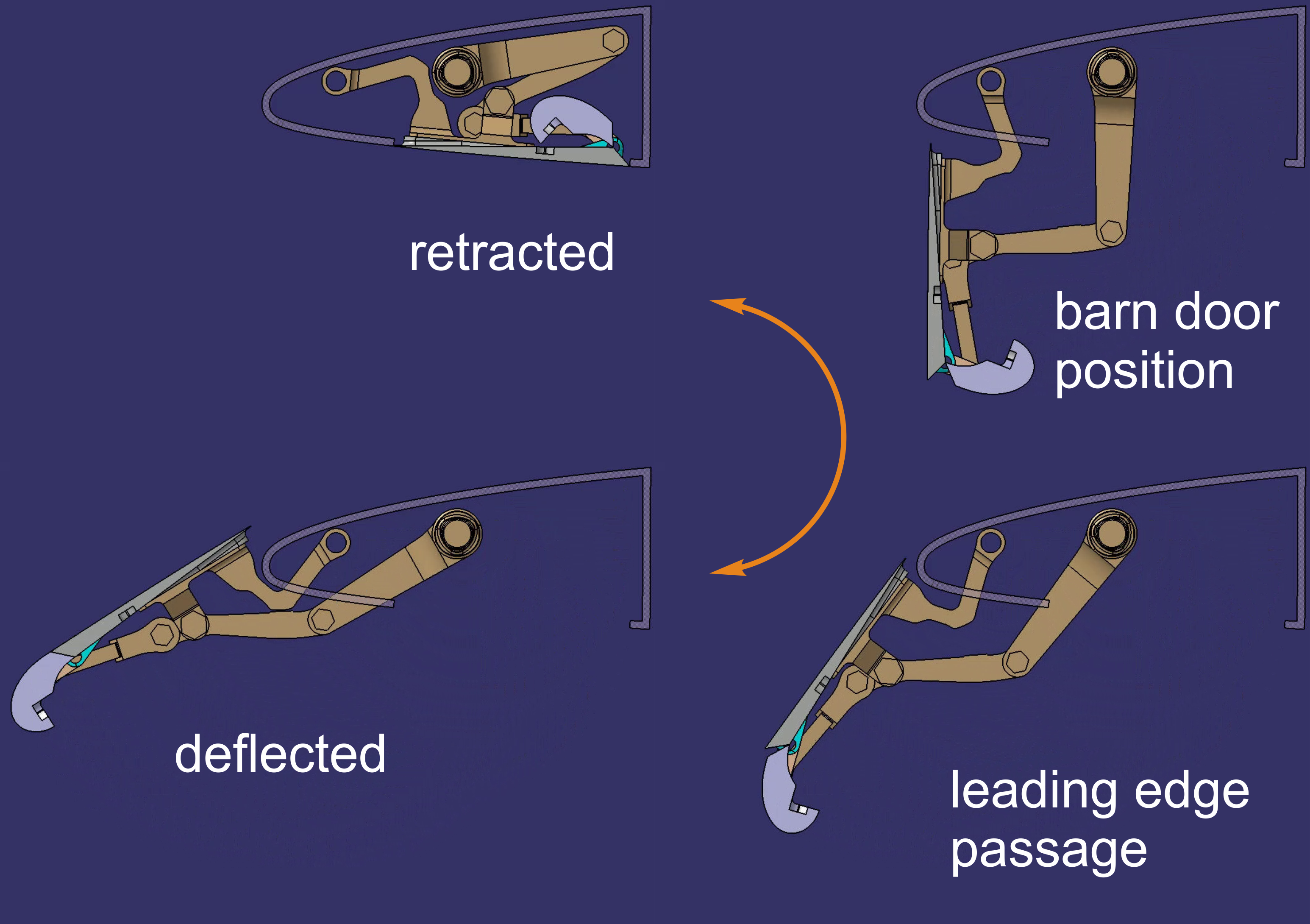
Krueger flap mechanism.
Contributions & Deliverables
- Development of an FSI coupling tool for Krueger deployment simulation (Phase 1 - 2)
- FEM analysis and structural model validation for wind tunnel testing (Phase 2)
- FSI assessment and load envelope quantification at aircraft level (Phase 3)
- Database management and data exchange infrastructure for project partners (ongoing)
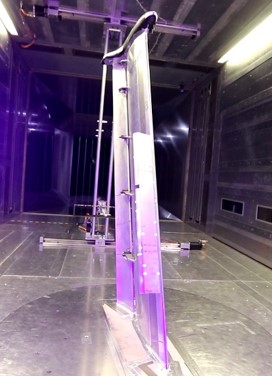
Prototype in wind tunnel test section.
Partners
IBK Innovation GmbH & Co. KG
- Development of the CFD–CSM FSI interface based on RBF interpolation techniques.
- Structural design and FE analysis of the Krueger panel and bull nose components.
- Operation of the project database and maintenance of the public project website.
CIRA
- CFD-based shape optimization of the Krueger element using kinematics-driven parameterization.
- Development and extension of the SIMBA Immersed Boundary method for moving bodies and FSI.
- Co-development of the CFD-CSM coupling interface together with IBK.
DLR
- Aerodynamic design and optimization of the Krueger geometry including load derivation for kinematics sizing.
- Development and application of Chimera techniques and local reconnection methods for moving grids.
- CFD validation against wind tunnel data and preparation of experimental datasets for consortium-wide comparisons.
KTH
- Hybrid RANS–LES simulations of unsteady Krueger flows including SA-DDES.
- Fully coupled FSI simulations using structural eigenmode representations.
- Assessment of aeroelastic stability and vibration levels of the Krueger system.
Airbus
- Definition of aircraft-level requirements for Krueger system design and operation.
- Specification of realistic deployment speeds and critical intermediate configurations.
- Assessment of impacts on aircraft design including weight, maintenance and aeroacoustics.
DNW
- Review and approval of structural integrity and instrumentation concepts for wind tunnel operation.
- Integration and optimization of pressure measurement modules within the models.
- Execution and support of large-scale wind tunnel campaigns at DNW facilities.
ONERA
- Implementation of Chimera methods in the elsA solver with automated preprocessing.
- Execution of URANS simulations for complete deployment and retraction cycles.
- Provision of reference CFD solutions for validation activities.
ASCO
- Design, sizing and weight assessment of the Krueger kinematics at model and full-aircraft scale.
- Analysis of fail-safe concepts and regulatory constraints according to CS-25 and FAA requirements.
- Definition of the reference kinematic architecture for all structural and FSI investigations.
NLR
- Development of block-structured local grid refinement combined with Chimera methods.
- Flight dynamics simulations to assess the impact of Krueger deployment on handling qualities.
- Validation of static and dynamic CFD results against DNW wind tunnel data.
Methods, Tools & Facilities
Methods
CFD (URANS/EULER), FEM structural dynamics
Tools
In-house FSI coupling framework (IBK–CIRA)
Facilities
Wind tunnel testing at DNW facilities
Additional Information
Funding
- Grant number: 769088 – Horizon 2020
- “This project has received funding from the European Union’s Horizon 2020 research and innovation programme under grant agreement No 769088.”
Duration
September 2018 to August 2021