


PRODIGE – PRediction of aerOdynamics and hinge moment loaDs at hIgh Mach and fliGht REynolds number
PRODIGE delivers high-fidelity aerodynamic load and hinge moment data from transonic wind tunnel tests at flight Reynolds numbers. IBK coordinates the consortium, leads model design and manages the ETW experimental campaign.
Project Overview
The PRODIGE project (PRediction of aerOdynamics and hinge moment loaDs at hIgh Mach and fliGht REynolds number) was carried out under the Clean Sky 2 Joint Undertaking within the Horizon 2020 programme. The goal was to generate experimentally validated aerodynamic load and hinge moment data at flight-representative Reynolds and Mach numbers through a dedicated campaign in the European Transonic Wind Tunnel (ETW).
Modern aircraft development faces the dual challenge of improving efficiency while reducing design cycle times. High-fidelity aerodynamic data are often not available early enough in the design process, forcing engineers to rely on conservative empirical correlations or low-fidelity tools, which tend to overestimate loads and actuator requirements. This results in higher system weight, cost and longer certification efforts. PRODIGE directly addressed this bottleneck by producing a validated aerodynamic database for the accurate determination of control surface loads and hinge moments.
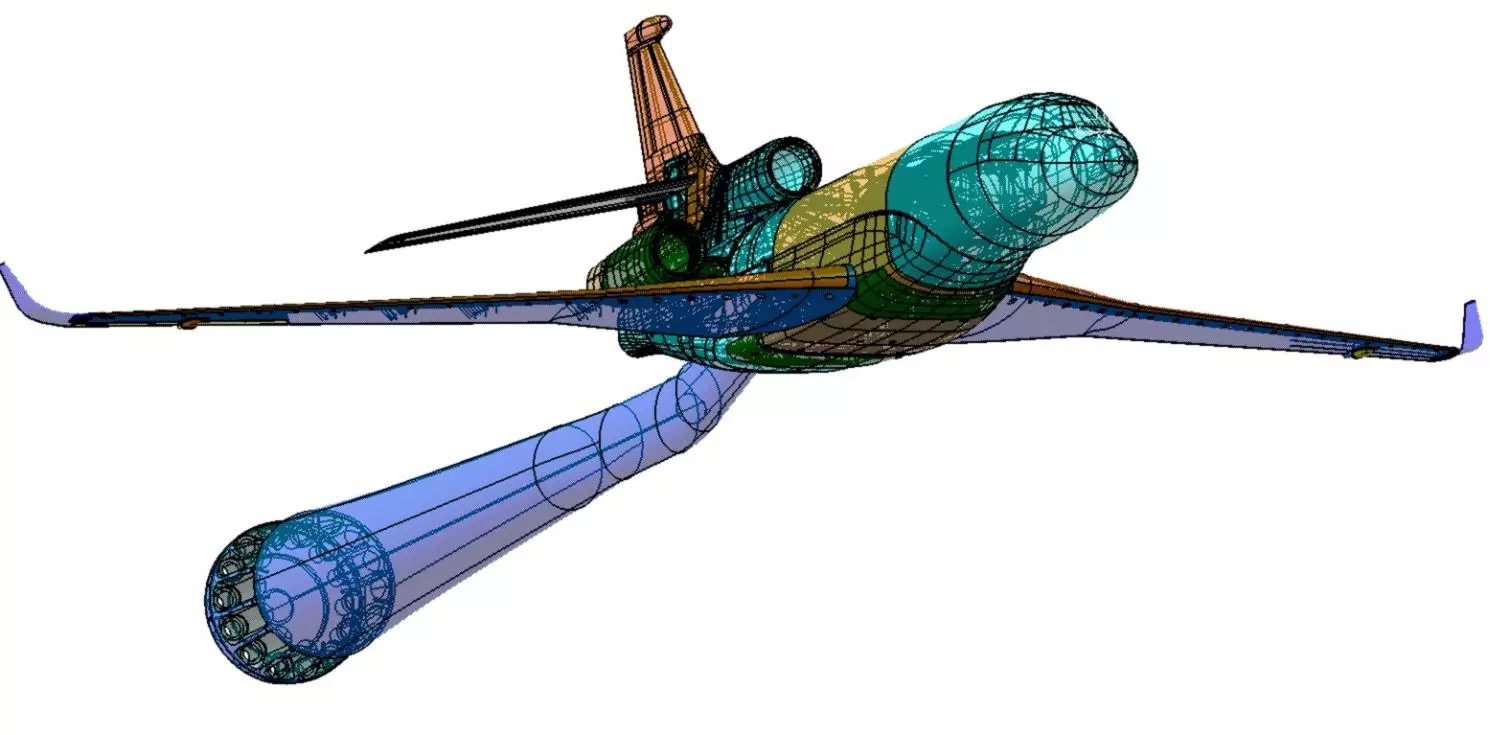
To achieve this, the project designed and built a 1:16-scale wind tunnel model of a business jet configuration, equipped with advanced internal instrumentation. The model enables precise measurement of aerodynamic forces, hinge moments, and local loads across a wide range of Mach numbers (transonic regime) and Reynolds numbers (flight-representative conditions). The tests are conducted at cryogenic temperatures and elevated pressures, replicating full-scale aerodynamic conditions.
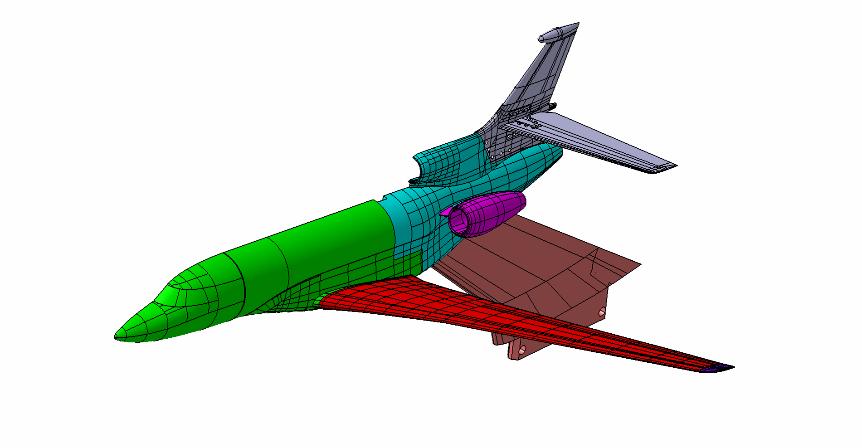
Numerical model.
PRODIGE investigated and integrated innovative measurement technologies to improve accuracy and reduce post-processing effort. These included internal load sensors (local balances) using strain-gauge and COTS force-cell technology, capable of resolving local hinge moments directly. Additionally, non-contact optical techniques were evaluated for measuring surface pressure distributions and structural deformations, enabling hybrid measurement strategies that combine direct and indirect data acquisition.
The experimental results provide a high-quality aerodynamic load database serving as a reference for validation of simulation-based load prediction tools. This database supports the broader virtual certification vision of Clean Sky 2 by enabling the correlation of CFD and structural models with accurate experimental results.
IBK Innovation GmbH & Co. KG acts as project coordinator and wind tunnel model design leader, managing both technical and contractual aspects of the ETW test campaign. IBK oversaw the integration of measurement systems, ensured aerodynamic and structural integrity of the model under cryogenic conditions, and coordinated with the manufacturing and instrumentation teams.
TU Darmstadt was responsible for the design, calibration and validation of the internal balances, while DEHARDE handled model manufacturing and instrumentation integration. DREAM Innovation srl supported the aerodynamic design through CFD simulations assessing load distributions, deformation effects and aeroelastic sensitivities.
By delivering accurate, high-Reynolds experimental data, PRODIGE significantly improves the fidelity of aerodynamic load estimation methods, reducing reliance on empirical corrections and paving the way toward digital, simulation-driven certification methodologies for next-generation aircraft.
Contributions & Deliverables
Coordination of the consortium and ETW test preparation (2018–2019)
Design and integration of a fully instrumented 1:16-scale business jet model (2019)
Management of high-Re ETW test campaign and data validation (2020)
Delivery of aerodynamic and hinge moment database supporting virtual certification (2020)
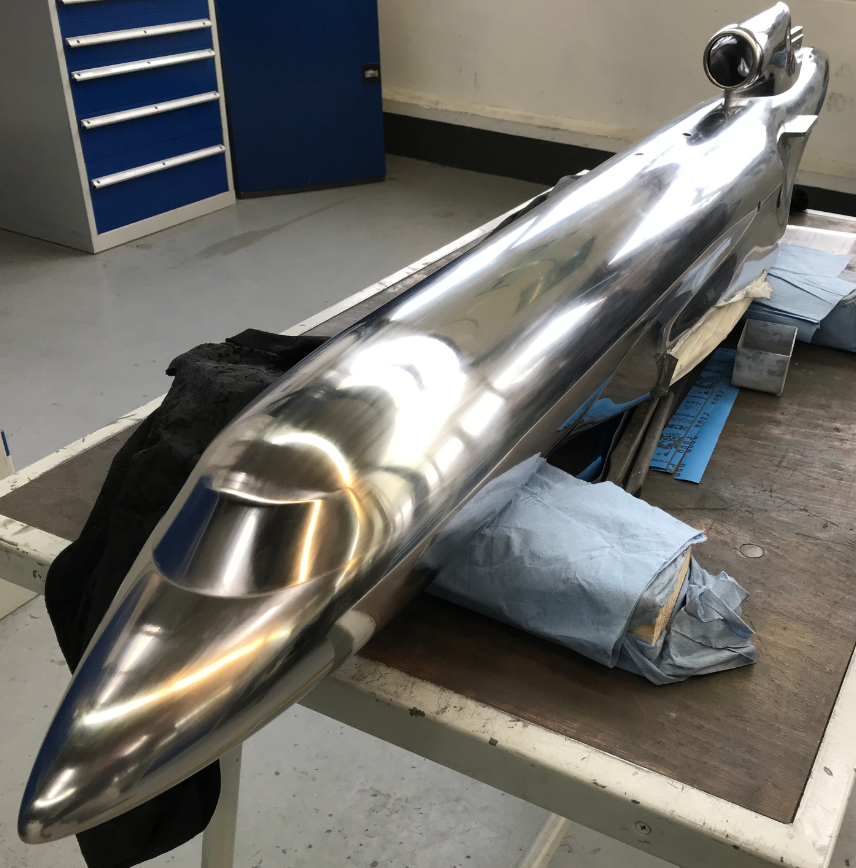
Polished wind tunnel model.
Partners
IBK Innovation GmbH & Co. KG
Project coordination, WT model design leadership, ETW campaign management
Technische Universität Darmstadt
Balance design, instrumentation, calibration and validation
DEHARDE GmbH
Model manufacturing and instrumentation integration
DREAM Innovation srl
CFD design support and aeroelastic analysis
Methods, Tools & Facilities
Methods
Cryogenic high-Re wind tunnel testing, local balance instrumentation, CFD-based load prediction, data correlation
Tools
CATIA, ANSYS, MATLAB, Python data analysis pipeline
Facilities
European Transonic Wind Tunnel (ETW), Cologne, Germany
Additional Information
Funding
- Funding body: Clean Sky 2 Joint Undertaking
- Program: European Union’s Horizon 2020 research and innovation programme
- Grant number: 785436
- “This project has received funding from the Clean Sky 2 Joint Undertaking under the European Union’s Horizon 2020 research and innovation programme under grant agreement No. 785436.”
Duration
03/2018 – 09/2020 (30 months)
Phases: model design and
instrumentation (2018–2019), ETW test preparation (2019), data acquisition and post-processing (2020).