



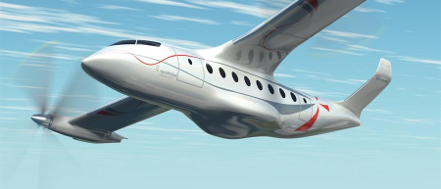
T-WING
T-WING develops, manufactures, tests and qualifies a composite wing for the Next Generation Civil Tilt Rotor Technology Demonstrator, IBK delivers aeroelastic and loads analyses, a load monitoring system and GVT support.
Project Overview
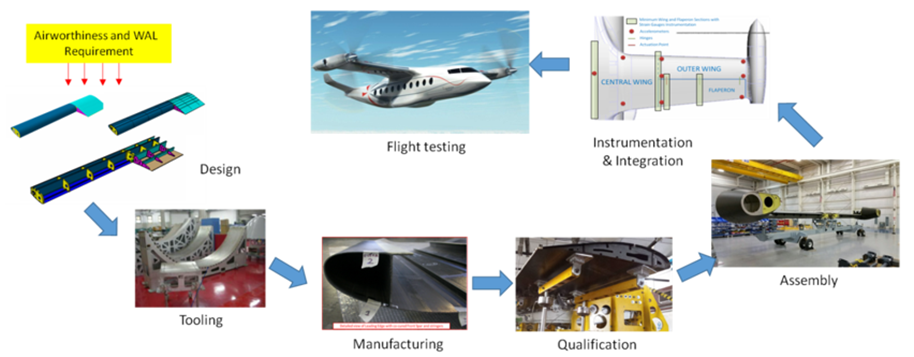
T-WING targets the end-to-end development of an innovative composite wing for the Next Generation Civil Tilt Rotor Technology Demonstrator, from system requirements and preliminary architecture to manufacturing, qualification and installation on the prototype. The consortium works in close cooperation with the Leonardo Helicopter Division during assembly, installation, ground tests and flight tests, with the additional goal of assessing scalability of solutions to a full-scale aircraft.
Tilt rotor configuration imposes unique design challenges. Thrust acting at the wing tips increases bending moments; nacelles with rotating machinery introduce significant masses and gyroscopic effects; transitional flight between helicopter and airplane regimes creates a wide envelope of operating conditions. To ensure safe margins for whirl flutter and aeroelastic instabilities, the structural concept requires carefully tailored spanwise distributions of torsional and bending stiffness, accurate inertia management and robust interfaces to nacelles, pylons and control surfaces. In parallel, the program must address life-cycle performance, maintainability and weight, therefore material and process choices are critical.
Following the System Requirements Review and the preliminary system design, aeroelastic analyses are performed to derive stiffness and inertia requirements, to define flight and ground load cases and to size the primary structure. Baseline concepts build on already certified and patented solutions from a T-WING partner that comply with CS and FAR 25 airworthiness requirements. The design process applies a multidisciplinary approach that couples aeroelasticity and loads, structural layout and composite stack optimization, systems integration, manufacturing constraints and qualification requirements. Special attention is given to innovative manufacturing technologies, including thermoplastic composites for improved damage tolerance and weldability, and additive layer manufacturing for metallic secondary parts to reduce mass, part count and waste.
Wind tunnel model.
Validation follows a staged strategy. Subcomponents are manufactured for intermediate tests that de-risk critical details. Three complete wing sets including fittings are produced together with rigs, jigs and tools. Two sets are dedicated to component and system qualification, including static limit and ultimate tests, fatigue, ground vibration tests in stand-alone configuration and after aircraft installation, crash resistance according to CS 29.952, bird strike, lightning, HIRF and functional verifications. The third wing set is integrated on the Technology Demonstrator for ground and flight tests. The program aims at reaching TRL 6 at project end, supported by a flight condition approval plan aligned with CS 25, CS 29 and special conditions, as applicable, and by Leonardo Helicopter Division requirements.
IBK Innovation supports CIRA in project coordination and is responsible for aeroelastic and loads analyses within the project perimeter. IBK designs the load monitoring system to enable in-service structural health evaluation and test correlation, and supports the University of Naples in the preparation and execution of ground vibration tests, including test planning, target mode set definition and correlation of experimental results with finite element models. Through this contribution IBK ensures that stiffness and inertia targets are achieved with sufficient margins, that flutter and whirl-flutter boundaries are verified and that the wing is qualified and ready for integration on the Technology Demonstrator.
Contributions & Deliverables
Aeroelastic and loads analysis package with stiffness and inertia targets, baseline released 2019, updates aligned with design gates
Design of load monitoring system, specification, hardware architecture and data pipeline, qualification ready 2021
GVT support with pre test predictions and post test correlation, stand alone and aircraft installed, campaigns 2022 to 2023
Whirl flutter boundary assessment and compliance evidence, report issued at TRL 6 verification
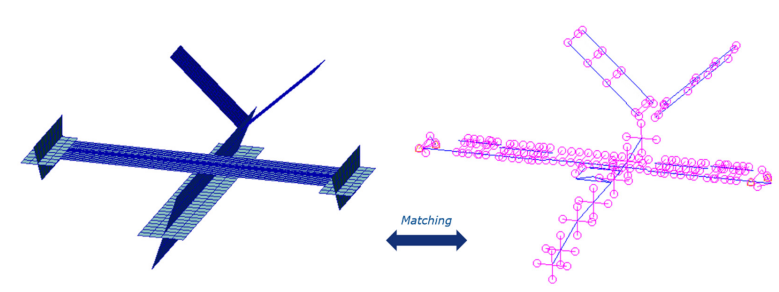
Aeroelastic model.
Partners
IBK Innovation GmbH & Co. KG
support to coordination, aeroelasticity and loads, design of load monitoring system, support to GVT
CIRA
coordination, preliminary design, support to aeroelastic analysis, support to technology development and qualification
MAGNAGHI
wing design and analysis, qualification tests
SALVER
manufacturing and instrumentation for tests
SSM
detail design support, construction drawings and detail analyses, crash analysis
UNINA
preparation and execution of GVTs
Methods, Tools & Facilities
Methods
Aeroelastic sizing, flutter and whirl flutter analysis, loads generation, composite optimization, life cycle assessment in design loop, structural health and load monitoring
Tools
NASTRAN, MSC Flight Loads and Flutter, ANSYS, MATLAB, Python, test data processing toolchain
Facilities
GVT laboratories at UNINA, qualification rigs at partners, assembly and integration at Leonardo Helicopter Division
Additional Information
Funding
- “This project has received funding from the Clean Sky 2 Joint Undertaking under the European Union’s Horizon 2020 research and innovation programme under Grant Agreement FOR Members (GAM) No. 807090.”
Duration
01/2018 to 12/2023, total 72 months
Notes, design and analysis, manufacturing and qualification, integration and TD testing, TRL 6 verification
at project end