



InSiDE
InSiDE advances aircraft ditching simulations by industrializing coupled CFD-FEM methods for water impact and structural response. IBK develops simulation workflows and validation models for design integration.
Project Overview
Detail summary
The InSiDE (Industrialized Simulation of Ditching Events) project focuses on developing and industrializing a validated simulation methodology for predicting the ditching behavior of commercial aircraft during emergency water landings. The objective is to provide an efficient, physics-based tool capable of analyzing fluid-structure interaction (FSI) with high accuracy and integrating it seamlessly into the early aircraft design process.
In the event of a water landing, aircraft manufacturers must demonstrate that the structural integrity of the fuselage remains sufficient to allow occupant evacuation without excessive flooding or failure. Conventional certification procedures rely mainly on experimental drop tests of rigid models, which are costly, time-intensive and difficult to extrapolate to full-scale configurations. To address these limitations, InSiDE develops and standardizes an officially approved, simulation-based methodology that meets certification-relevant fidelity standards while remaining computationally efficient.
The project is structured into three main work packages:
WP1: Industrialization of the simulation chain, including workflow automation, model standardization and documentation for industrial use.
WP2: Further development of the numerical models by integrating two-way coupled fluid-structure interaction (CFD-FEM) techniques capable of resolving large deformations, multiphase flows and impact dynamics.
WP3: Integration of the methodology into the industrial design process, enabling real-time or near real-time simulation feedback during preliminary design.
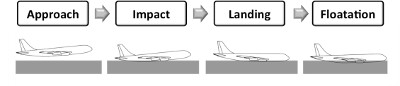
Principal process.
The two-way coupling approach combines computational fluid dynamics (CFD) for modeling the multiphase water impact and finite element methods (FEM) for capturing local and global structural deformation. Higher-order coupled schemes are employed to simulate both rigid-body motion (e.g. trimming, pitch) and local panel responses. The resulting models enable engineers to assess ditching loads, energy absorption, structural damage risk and water ingress potential with unprecedented accuracy.
These capabilities make it possible to evaluate design concepts such as energy-absorbing fuselage structures, engine attachment breakaway loads or optimized landing gear bays at an early stage. The approach directly supports certification-related evaluations and reflects the increasing trend toward simulation-based regulatory acceptance by airworthiness authorities.
IBK Innovation GmbH & Co. KG contributes to InSiDE through the development, automation and validation of the coupled simulation framework. IBK’s role includes establishing a standardized process chain suitable for industrial use, setting up FSI simulation models, and validating them against available test data. Furthermore, IBK supports the definition of certification-relevant load cases and implements parametric workflows enabling efficient geometry and condition variation studies.
Through InSiDE, the consortium provides a major step toward a unified, simulation-driven ditching analysis process that will enable aircraft manufacturers to design for water impact robustness with reduced reliance on large-scale experiments. The results support both safety improvement and cost efficiency within future certification frameworks.
Contributions & Deliverables
Development of standardized, process-compatible FSI simulation workflow (2023)
Implementation of automation and pre/post-processing routines (2024)
Validation of coupled CFD-FEM simulation chain against TUHH reference cases (2024)
Integration of simulation methodology into early aircraft design toolchain (2025)
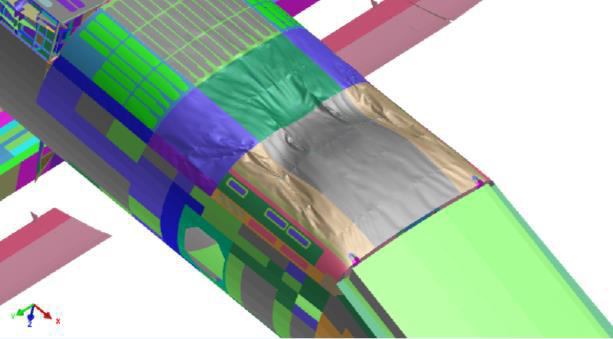
Structural deformations on the entire aircraft using a semi-analytical method for calculating hydrodynamic loads.
Partners
IBK Innovation GmbH & Co. KG
- Industrialized the complete ditching simulation process by integrating elastic aircraft structures into the DFTS Low-Fidelity environment.
- Defined standardized workflows, model building rules and interfaces enabling application in industrial design processes.
- Led validation and realistic use cases to demonstrate robustness and readiness up to TRL-4.
German Aerospace Center (DLR)
- Conducted High-Fidelity fluid-structure interaction simulations with detailed FEM models for local deformation effects.
- Delivered high-quality reference data for validation of the simplified and hybrid methods.
- Led the validation activities to assess accuracy and physical consistency of the overall process.
Hamburg University of Technology (TUHH) - Institute for Fluid Dynamics and Ship Theory
- Developed the core hydrodynamic modeling of water impact within the “ditch” solver.
- Implemented Low-Fidelity and hybrid FSI concepts to include structural deformation effects in fast simulations.
- Established quality management and robustness criteria for numerical stability and reliability.
Methods, Tools & Facilities
Methods
Two-way coupled CFD-FEM, multiphase flow modeling, impact dynamics, FSI validation
Tools
LS-DYNA, Ansys Fluent, STAR-CCM+, Python automation
Facilities
TUHH’s Fluid Dynamics and Ship Theory (M8) water impact lab, DLR structural test facilities
Additional Information
Funding
- Funding body: Bundesministerium für Wirtschaft und Klimaschutz (BMWK)
- Program: LuFo VI-1
- Grant number: 20Q1951A
- “This project is funded by the German Federal Ministry for Economic Affairs and Climate Action under the national aviation research program LuFo VI-1.”
Duration
01/2022 – 08/2024
ongoing Project phases: model industrialization (2022–2023), coupled simulation development (2023–
2024), validation and design integration (2024–2025).